
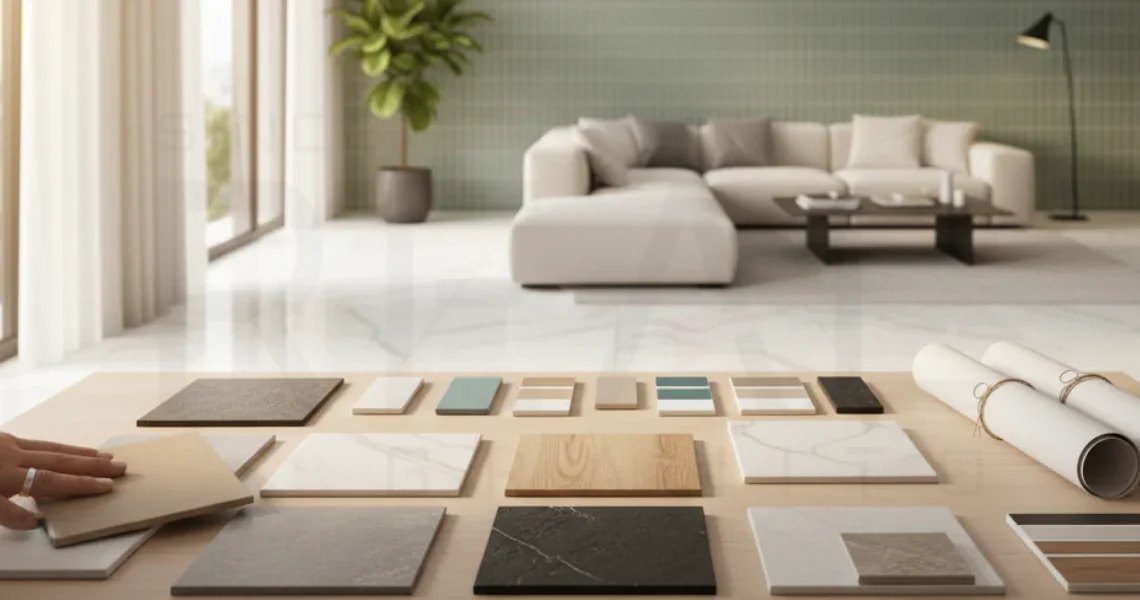
Most investors walking a unit before a purchase or renovation lock in on the obvious: layout, kitchens, bathrooms, the view. Flooring gets a glance and a shrug. But the tile on the floor covers every square foot of the property, and it takes a beating every day it’s in service.
Get it wrong and you’ll hear about it. Tenants complain, buyers negotiate down, and repair invoices pile up. So how do you pick tile that protects a property’s value instead of slowly bleeding it?
Ceramic and Porcelain Are Not the Same Product
In the showroom, the two look nearly identical on the display board. The price tags don’t match. There’s a reason, and it matters more than most first-time landlords think.
Ceramic tile has a softer, more porous body. Porcelain, sold in Singapore as homogeneous tile, is fired denser and absorbs far less water. According to one supplier breakdown, ceramic bodies can absorb up to 6% water, compared with roughly 0.5% for porcelain. That gap sounds academic until you picture a wet bathroom, a leaking pipe, or a kitchen with steam and oil hitting the floor every night.
For rental units and resale properties, the denser tile pays for itself. It stains less. It chips less. And it doesn’t soak up moisture that later feeds mold behind the skirting.
PEI Ratings Tell You What the Tile Can Actually Take
Most buyers pick tile the way they pick paint: by color. That’s a mistake when the surface has to survive years of foot traffic, luggage wheels, and furniture dragged around by tenants who don’t own the place.
There’s a published scale for this. The PEI rating system grades glazed tile abrasion resistance from Grade 1, which is wall-only, up through Grade 5, rated for heavy commercial traffic. Most residential floors land at PEI Grade 3.
- Living rooms and bedrooms. A Grade 3 tile handles normal household wear without showing scuffs early.
- Entryways and kitchens. Step up to Grade 4, especially in rentals where turnover means more moving-day abuse.
- Balconies and shared corridors. Higher grades with slip-resistant finishes protect you from both wear and liability.
Installation Quality Decides Whether the Tile Lasts
A premium tile installed badly is a worse investment than a mid-range tile installed right. Owners tend to underweight this because they can see the tile but not the workmanship underneath it.
Two things to watch. First, lippage, meaning the height difference between adjacent tiles. ANSI A108.02-2023 sets the tolerance: for grout joints between 3 mm and 6 mm wide, the standard allows 1 mm plus the inherent warpage of the tile. Any more and you feel it under a bare foot.
Second, adhesion. Popping tiles are a frequent defect complaint from homeowners, and the causes usually trace back to installation method, thermal movement, trapped moisture, or adhesive that wasn’t up to the job. Fix the process before the tile goes down, not after it lifts.
Match the Tile to the Room, Not the Mood Board
It’s tempting to pick one tile and run it through the whole unit for a clean look. Sometimes that works. Often it doesn’t, because a floor that photographs beautifully in a dry living room can be exactly wrong at the shower threshold.
Think room by room. Wet zones need lower water absorption and better slip resistance. High-traffic paths need higher abrasion ratings. Bedrooms can prioritize appearance because the wear demands are lower.
Browsing curated project galleries, like this collection of homogeneous tile design ideas, is a practical way to see how experienced designers pair specific tile types with specific spaces before you commit to an order. The best-performing floors are usually a small, deliberate mix. Two or three tile choices, each doing a job the others can’t.
Think in Decades, Not Renovation Cycles
Flooring is disruptive to replace in an occupied home. Furniture out, dust everywhere, tenants displaced. So the real cost of cheap tile isn’t the tile. It’s the second renovation.
This is where dense, unglazed full-body porcelain earns its keep on floors that will be walked on for the long haul. Tiles conforming to DIN EN 14411 Group BIa are considered to have some of the highest deep-abrasion resistance of any floor covering material available. That’s the kind of surface that still looks presentable at year fifteen, when a cheaper tile would already be on its second replacement.
For an investor, that math is the whole point. Every year you don’t have to re-tile is a year of rent, resale readiness, or peace of mind. Pick the tile the way you picked the property: with the long hold in mind.